














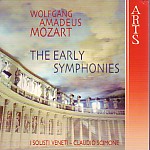
The numbering and chronology of Mozart’s early symphonies is a bit of a mess, made all the messier by the numerous revisions of Köchel’s catalog over the years. These four discs contain Symphonies Nos. 1, 4-8, 10, and 12-19, plus five other miscellaneous unnumbered works, as well as the charming Gallimathias musicum K. 32. The performances, as might be expected from Claudio Scimone and I solisti veneti, are stylish and lively, with spirited allegros, nicely singing andantes, and smartly paced minuets. Ensemble coordination is consistently first rate: rhythms are well pointed and phrasing is impressively uniform.
Scimone’s approach is typical of non-period-instrument chamber orchestras, in that the strings dominate (and play very well), with oboes and horns less prominent. Whether this is a drawback or not will be a matter of personal taste; certainly the music sounds just fine, and since none of it is major Mozart there’s no need to belabor the point. It’s worth noting, however, that the harpsichord continuo, selectively used in the earliest works, stays in the background where it belongs. The recordings, made during the period 1991-98, are a touch reverberant but fall easily on the ear. If you’re looking for a passel of early Mozart in shapely, traditional performances by a good chamber orchestra, you should certainly consider this set.