














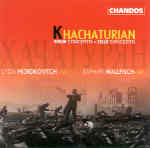
Every 10 years or so, record companies like to root around their catalogs, resurrect good samples, pair them up differently from their original incarnations, and send them out to an unsuspecting public. This time around, Chandos has combined two fine performances of Khachaturian concertos that initially were released alongside Kabalevsky works, but the company might have waited a year or two, as the original releases are still in print and available from some outlets. Nevertheless if you want pure Khachaturian and don’t have a programmable CD changer, this disc gives you straightforward, well-played performances in excellent sound.
Lydia Mordkovitch, a former assistant to David Oistrakh, the dedicatee of the violin concerto, gives a dazzling, spunky reading of this intoxicating work and is supported by Neeme Järvi and the Scottish National Orchestra with vivacious accompaniment. Chandos’ sonics are the main advantage in a field crowded by Oistrakh’s several “authoritative” recordings (with the composer on EMI, the first-ever recording under Alexander Gauk, now on Pearl, and a radio broadcast recording with Kubelik on Praga) and Leonid Kogan’s brilliant 1958 performance under Monteux on RCA. In other words, you can’t go wrong with Mordkovitch, but the others are just that much more captivating.
The cello concerto is rarer fare (only two other recordings available) and usually has been overshadowed in the cello repertoire by contemporaneous and more popular works by Shostakovich, Prokofiev, and Kabalevsky. Like most pieces by Khachaturian, this concerto is suffused with the exotic influence of Armenian folk-tunes and is full of the same rhythmic propulsion, startling dissonances, and eerie orchestral color (the flutter-tongued flutes at the beginning and end of the second movement, for instance) that mark his better-known works. For instance, the pulsing motif in the opening of the third movement recalls the famous “Sabre Dance” from his ballet Gayenne (a work that along with the violin and cello concertos was written in the 1940s). By no means does the entire concerto hold interest all the time, as there are some meandering parts and the structure does not always cohere. Raphael Wallfisch really gives it his all, though, and proves a passionate advocate throughout. [6/11/2002]