














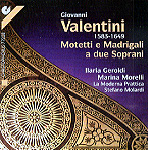
While little is known of the early life and career of Italian composer Giovanni Valentini (1583-1649), his profoundly successful later association with Archduke Ferdinand in the Habsburg court–and the music this service produced–speaks well enough. Indeed, Valentini (not to be confused with Giuseppe Valentini, who lived almost exactly 100 years later and whose early life is equally sketchy) spent 35 years composing collections of madrigals and motets, as well as magnificats (including one for seven choirs and trumpets), masses, and other sacred and secular works for Ferdinand and his successor. The pieces on the present recording–for both one and two sopranos accompanied by various stringed instruments, harpsichord, and/or organ–represent a genre favored by Valentini and one that obviously greatly pleased his patrons. The informative liner notes (complete with details regarding sources) tell us how handsomely the composer was rewarded financially–8,000 gulden–for one of his duet collections, Musiche a doi voci. The style is reminiscent of Monteverdi’s solo vocal works, characterized by highly expressive, extended, floridly ornamented vocal lines, frequently interrupted by dramatic pauses. And in Valentini’s case it doesn’t matter whether the texts are sacred or secular: the dramatic/emotional cast is the same. Texts range from familiar sacred ones–Hodie Christus natus est; O bone Jesu–to equally familiar secular themes of love, longing, and “bitter torment”.
If this is your sort of thing–and I must admit that this extreme manner of melodic ornamentation, with rhythms alternately squeezed and stretched like a Slinky on a flight of stairs, simply leaves me desperately searching for a tune to hold on to–then you’ll find this program a worthy entertainment. The two singers, whose voices are characterful and strong and slightly quivery of vibrato, are well versed in the style, reveling and languishing where they deem appropriate as they compel our attention and use every wile of voice and inflection to make the words felt and well as heard. They are accompanied by equally accomplished instrumental players, who understand that their role often rises far beyond mere harmonic support, thus providing some real interest in the internal parts. And there’s certainly no denying the quality of the music, especially in a purely dramatic sense, as Valentini really understands how to build tension and play with emotions. Just listen to the effectiveness–and the economical way he achieves it–of the two-part madrigal Lasso dove son io. The two sopranos really seem to love performing this music, tearing at our hearts with every shuddering, shaking turn and trill in the madrigal Ti lascio anima mia (I leave you, my soul, the hour is come). Their efforts are all the more affecting due to the clear, crisply detailed, natural sound from the Palazzo Visconti, Cremona.