














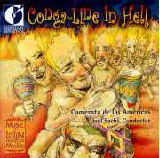
Conga-Line in Hell is one of those rare discs that not only makes thematic sense but also happens to be hugely enjoyable from beginning to end. The disc’s somewhat alarming title is taken from the delightful opening piece from 1994, the Uruguayan Miguel del Águila’s sly conga that layers Latin American dance rhythms over a repeating piano figure (think Philip Glass, but with a sense of humor). Don’t let the title (or the cover art) put you off: this is a great sampler of new and 20th-century music from the Americas, an area that has long been of interest to Joel Sachs, who is probably best known for his work in New York directing two new-music groups, Continuum and the New Juilliard Ensemble. His conducting on disc, as in live concerts, always is sharply articulated and well-thought-out. The Camerata de las Américas is a top-notch group of players who sound as if they’ve been playing this repertoire forever (showing incredible tightness and focused sound), but also as if they are still completely entranced by the many charms of this music.
And so they should be; it’s a terrific program. The Mexican composer Arturo Márquez, whose early works were heavily influenced by Messiaen and Berio, eventually turned to the music of his youth for inspiration. 1988’s Danzón No. 4 is one result, in which the melody is sinuously carried by the oboe, flute, and saxophone, fed from a spring of strings and percussion. Conlon Nancarrow, the American who left for Mexico and who perhaps is the best-known name in this group of composers, is represented by 1943’s First Piece for Small Orchestra, a rhythmically piquant but tonally blues-flavored work. The Puerto Rican composer Roberto Sierra’s 1997 piece Cuentos (Tales) spans three evocatively-titled movements: the explosive shrieks of “Lenguas desconocidas (Unknown Languages)”; “Lo que pasó en las nubas (What Happened in the Clouds)”, reminiscent of Messiaen’s shimmering textures; and “Batata-Coco”, a wild mambo homage to the great bandleader Pérez Prado.
Another composer to make use of Caribbean dance sounds is Nadia Boulanger’s Cuban student Alejandro García Caturla, whose First Cuban Suite from 1932 draws as much from the son, comparsa, and danza styles as it does from Stravinsky. (Listen to the ominous opening of the movement titled “Comparsa” and compare it to the first sounds of the Rite of Spring.) Another piece from the ’30s rounds out the program: 1937’s Flôr de Tremembé (Tremembé Flower) by Brazilian composer Mozart Camargo Guarnieri, which starts out in something of a fugue propelled by Brazilian percussion, then blossoms into a festive whirl of color. The sound is great: wide, but still very crisp.