














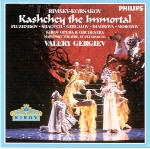
Rimsky-Korsakov’s Kashchey the Immortal is virtually unknown in the United States. When it was premiered in Moscow in l902 the audience cheered, but the composer felt they were “at a loss” over the work nonetheless, and only cheered because the Moskovites “have a weakness for me.” And to be sure, the musical language of this hour-long one-acter was somewhat revolutionary: it is madly chromatic and impressionistic in a way that the Russians certainly had not encountered before. To our ears it simply sounds like Rimsky at his best–lyrical and colorful, with the occasional odd rhythm, with melodic motifs running throughout.
The story involves the eponymous powerful wizard-like character, his seemingly heartless daughter whose inability to cry keeps him immortal, the Princess he keeps imprisoned, and the Storm Knight, who appears to work for Kashchey, but who actually saves the day and reunites the Princess and her Prince, Ivan. When Kashchey’s daughter falls in love with Ivan and it is unrequited, the Princess, empathizing, kisses her and the latter weeps, thereby destroying her father’s realm and power. Yes, I know, nonsense–but the tale is woven with such skill and speed, and the characters are so well drawn, that five minutes into it, it all seems viable.
A Russian wing of Harmonia Mundi released a recording of this opera a few years ago, and while it is nicely atmospheric, this set, which is better sung, played, and recorded, renders it unnecessary. This recording is ideal: Marina Shaguch’s Princess is both strong and touching; Konstantin Pluzhnikov’s Kashchey–a character tenor role–is suitably power crazy and relentless; the wonderful Larissa Diadkova, as Kashchey’s complicated daughter, is heartless until she turns around emotionally, at which point she’s immensely moving; Alexander Gergalov brings dignity to Ivan’s music; and with little to do other than move the plot along, save the day, and fly through the air, Alexander Morozov’s Storm Knight is excellent. Valery Gergiev makes a great case for the opera and his Kirov forces play and sing eloquently. This is a many-faceted, brightly-colored gem.