















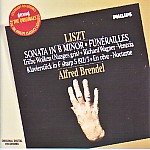
Focusing on the score rather than the show, Alfred Brendel communicates and organizes the Liszt Sonata’s structural threads and contrapuntal interest with forthright intensity, concentration, and integrity. That said, we still must deal with the pianist’s bleak, bloodless tone in loud passages, and a lack of the kind of effortless sweep and long, singing line in bravura passages we hear from Argerich, Arrau, Bolet, and Richter. Still, this 1991 recording gains a soupçon of presence and color via Philips’ “original masters” refurbishing.
Heard alongside Brendel’s more distantly miked 1981 Philips Liszt Sonata, the remake essentially preserves a similar interpretive game plan, but with differing details. Just a few examples: the stringendo chord leaps and broken octaves (track 2, 8:12) and the fughetta come off less urgent and incisive than before, yet transitional passages are more flexible, fluid, and harmonically pointed; in the Funérailles Brendel takes trouble over the alternating left-hand booming bass notes and chords in order to rub the grim funeral march in your face, and rightly so; also notice how the central episode’s fully voiced right-hand chords and galloping left-hand octaves interact in dialogue, in contrast to all those pianists who barnstorm their way through the music. Brendel also captures the late works’ foreboding qualities, save for a rather cut-and-dried, poker-faced En rêve. The booklet includes Brendel’s own heartfelt, insightful annotations.