














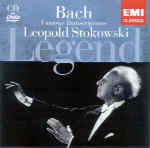
You don’t have to be a historical performance dogmatist to object to romanticized transcriptions of Bach’s organ music, but these performances under Leopold Stokowski’s magic wand of what are labeled his own transcriptions will induce willing suspension of disbelief on the part of most music lovers. Ideological rigidity is as nasty a phenomenon in music as it is in politics, and for the duration of this disc in EMI’s new “Legends” series, unalloyed joy awaits any music-lover open to even the most anachronistic listening experiences.
The oft-reissued performances on this disc have been recycled with a twist; like others in EMI’s “Legend” series, a bonus DVD disc is included, this one featuring a 1972 video of Stokowski’s London performance of Debussy’s Prélude à l’après-midi d’un faune and a “highlight” roundup of EMI’s Classic Archive DVD series. But if you don’t have earlier releases of this disc, it’s recommended for anyone who’s ever fallen under Stokowski’s spell, for the sorcerer here performs his magic on 11 famous Bach works, from organ masterpieces like the C minor Passacaglia and Fugue BWV 582 and the Toccata and Fugue in D minor BWV 565 to the Sarabande from the first Violin Partita and the so-called “Air on the G String” from the Orchestral Suite No. 3.
An organist himself, Stokowski stresses different aspects of orchestral sonority in these settings. The big organ works mentioned above have rich, sumptuous strings, brilliantly scored winds, and climaxes Bruckner would have been proud of. The “Little” Fugue in G minor, a longtime Stoky favorite, is irresistibly catching, the melody permanently lodged in your brain after one hearing. This string version of the song “Mein Jesu, was vor Seefenweh” BWV 487 is freighted with intense emotion undreamed of in the original. Other tracks cast a similar spell, though at times it’s hard to avoid thinking of a grande dame tarted up to the point where she’s transformed into a call-girl. But that too, was part of Stoky’s powers of enchantment: to transform the sublime to the vulgar, even as he transforms the mundane to the magical. The terrific-sounding orchestra is a New York pickup group labeled “His Symphony Orchestra” on the original recordings, and the 1957 sonics come up fresh as daisies, a tribute to the gifts of the original producer, the legendary Richard C. Jones. [7/30/2004]