














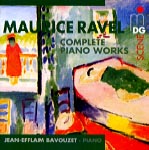
The late Arturo Benedetti Michelangeli allegedly claimed that no piano in the world was good enough for Ravel’s Gaspard de la nuit. Obviously he didn’t live to hear the vintage 1901 Steinway grand used in Jean-Efflam Bavouzet’s complete Ravel cycle for MDG. Timbre is hard to describe in words, but I’d compare this instrument to a modern American Steinway model much as I’d compare a handcarved oakwood table to a factory-made Formica copy. More importantly, Bavouzet is a superbly equipped virtuoso who puts the music first. Local color, rubato fancies, and similar interpretive touches organically arise from what the score tells Bavouzet, not the other way around. You hear everything in Valses nobles et sentimentales except for a pianist intentionally striving for this or that effect (as in Ivo Pogorelich’s recording). Bavouzet takes special care to articulate, shape, and give meaning to the rotary patterns that permeate the outer movements of Gaspard de la nuit and the Sonatine, and he projects the linear trajectory of the central movements more cogently than most pianists.
Similar revelations occur in Miroirs: there’s more going on in Noctuelles than your standard misty-eyed, “atmosphere”-oriented interpretations suggest. Une barque sur l’océan’s terraced dynamics are flawlessly observed, and Alborada del gracioso is deliciously brisk and pointed. Listen to Bavouzet’s subtle voicings and canny accents in Le Tombeau de Couperin’s Prelude and you’ll imagine two pianists on two separate vintage Steinways. Following the tenderly spun Fugue, the Forlane seems a shade brusque and flippant (Rubinstein’s sexy glow comes closer to the mark), but these qualities certainly liven up the Rigaudon–and what a light, crisp, rhythmically dead-center Toccata Bavouzet tosses off! He nails just the right tempo for Jeux d’eau and the Pavane, takes a more leisurely stroll than most through the little Prélude, and brings a specific character to each of the other small works.
The engineering may not match the warmth and immediacy of Alexandre Tharaud’s Harmonia Mundi Ravel cycle, or Angela Hewitt’s for Hyperion. And listeners who’d prefer a suaver, less idiosyncratic concert grand may find Abbey Simon (Vox), Jean-Yves Thibaudet (Decca), or Louis Lortie (Chandos) to be safer recommendations. Yet Jean-Efflam Bavouzet’s individual, intelligent, and accomplished Ravel interpretations shed a fresh and hopefully lasting light on this timeless repertoire.