Blog

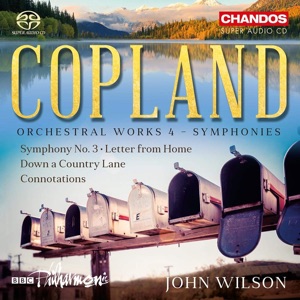
  • Shallow Copland Third from Wilson and the BBC Phil

    This release is billed as Orchestral Works 4, and Symphonies Vol. 3, which strikes me as a bit of overkill, especially given the fact that Copland’s output was not that large. Never mind. The performance of the Third Symphony is swift and light, with the slow movement coming off best because it requires the least amount of rhetorical emphasis. It’s not a bad performance, but with the likes of Bernstein and Slatkin already available in two recordings each, never mind the composer’s own versions (Everest better than Sony), you can’t help but feel that this outing is superfluous.

    The BBC Philharmonic remains one of the least interesting ensembles around: always professional, but always bland. Just listen to that phlegmatic central climax in the finale, before the coda. It should shock with its dissonance and acerbity–all the more given the springy pleasantness of the music that precedes it. Not here. Wilson’s choice of Copland’s less effective original ending, which Slatkin recorded for Naxos and which I never hoped to hear again, doesn’t help.

    As for the remainder of the program, well, Letter from Home and Down a Country Lane are cute but ephemeral. Connotations, on the other hand, is a major work and, like the symphony, it’s well played but needs more gruffness and angularity. You get the sense listening to these performances that the artists are sincere about what they are doing, but they simply haven’t rehearsed the program long enough to convey a full sense of commitment to the cause. Good sound, but this disc is nothing to get excited about.
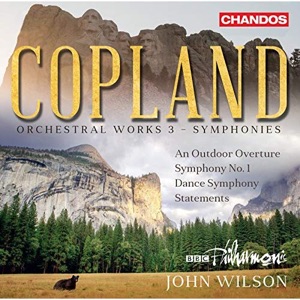
  • Enjoyable (Mostly) Early Copland from Wilson

    A pattern in this series is starting to emerge. John Wilson and the BBC Philharmonic tend to do better in Copland’s earlier works. The reason isn’t hard to fathom. These pieces are stylistically more diverse and exploratory, as well as less personal, than his later music, and they respond better to interpretations noteworthy for accuracy and a certain “French” deftness. A case in point is the First Symphony, here in its fully orchestral guise. Wilson has already made an excellent version of the original score for organ and orchestra, and so here we have essentially the same performance.

    The Dance Symphony, based on the early ballet Grohg, has passages remarkably similar to those in the First Symphony (the quick music especially), and this version is equally sympathetic. I confess to having a soft spot for Statements, a gruff work where glimpses of the later, more rhetorically declarative composer begin to emerge, and here you start to notice that the playing could be more emphatic in spots, though Wilson’s pacing and ear for detail are undeniably expert.

    The Outdoor Overture though, a piece of unabashed musical populism, lacks the brashness and color that its simplified style requires. And why do English orchestras insist on using those swooshy, clodhopper cymbals that have so little impact at the climaxes? This is the only work on the disc where you can really hear what’s missing in Wilson and the BBC’s performances of the later works: sheer character. For the most part, though, this recital is a winner, and a useful collection for those looking for a handy collection of less than usual Copland.

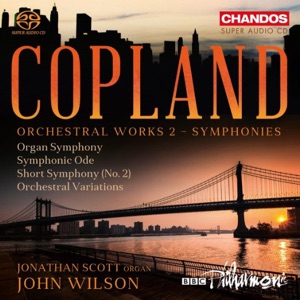
  • Fine, Unpopular Copland from Wilson and the BBC

    This disc, Volume 2 in John Wilson’s ongoing survey of Copland’s orchestral music on Chandos, contains some of his least well-known orchestral music, but also some of his most rewarding. There were two prior discs that gave us something similar, both on RCA. The first, from Slatkin and St. Louis, left off the Symphonic Ode but included the Dance Symphony. Next, Michael Tilson Thomas and San Francisco released a disc called “Copland: The Modernist” that omitted the Organ Symphony but featured the Piano Concerto. You may not be able to find those earlier releases, but if you can, those are your choices.

    The present release, in the event, is very good, better than the first volume of more popular stuff if only because the repertoire is less overexposed. The Organ Symphony, which Tilson Thomas did get around to (excellently) on the San Francisco Symphony’s proprietary label, is extremely well played and recorded here. Jonathan Scott’s registrations are sensitively chosen to combine and contrast with the orchestra, and the instrument itself sounds marvelous. Both the Orchestral Variations and the Symphonic Ode also receive impressive readings, perhaps not quite as sharp and angular as the music could be, but this is only an issue–and not a big one–in the outer movements of the Short Symphony, one of Copland’s very greatest works. Throughout, Wilson’s pacing is expert.

    As already suggested, the sonics are typically spacious, perhaps a bit too much so for the Short Symphony’s chamber music textures, but then again its slow movement has remarkable warmth in this performance, and there’s always the Orpheus Chamber Orchestra if you want to hear the music at its most pungently incisive. A very enjoyable release.

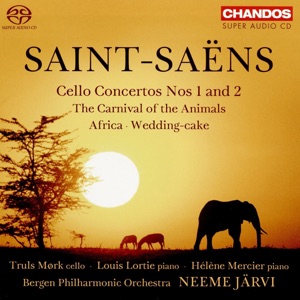
  • A Great Saint-Saëns Release from Mørk, Lortie, Mercier & Järvi

    This disc is as beautifully planned as it is played and engineered. The two Saint-Saëns cello concertos are superb pieces–succinct, shapely, melodically memorable, passionate and charming by turns. They don’t get much respect in musical circles, but Truls Mørk plays both of them magnificently. His impeccable intonation, total freedom from unwelcome performance noises, restrained but colorful vibrato, and sweet timbre throughout all registers combine with Järvi’s propulsive accompaniments to produce performances that can only be called “noble.” They do the music proud at every point, especially in the First Concerto’s central Allegretto con moto, which is just delicious.

    The program then pivots around a zesty, graphic account of The Carnival of the Animals, with Mørk on hand as The Swan, and Louis Lortie and Hélène Mercier capably tossing off the two piano solos. Having thus introduced the keyboards, Lortie wraps up the concert with the “Wedding-cake” Caprice and the Africa fantasy, this latter a spectacular work performed with all of the glitter and gusto that it requires. There are so many splendid short piano-and-orchestra pieces that we only get to hear on recordings, and these are certainly two of them.

    As you can plainly see, a great deal of care obviously went into assembling this program, and the result is disc that you can dip into at will, or play straight through as a thoroughly coherent and wonderfully representative concert that reveals Saint-Saëns at his best throughout. A home run in every respect.

  • Reference Recording: Malikova Plays Saint-Saëns, Volume I

    We badly need a first-rate Saint-Saëns piano concerto cycle in […]

    To access this content you must login to your Insider account, or purchase a subscription for $5 monthly, or $49 annually.
  • Jansons’ Bruckner Lite. Yech!

    The Royal Concertgebouw Orchestra has several recordings of this music under its belt, including two fine ones from Haitink on (formerly) Philips. This one sucks. It is swift, faceless, lacking in depth, projection, grandeur–in short, all of the things that we usually want to hear in this music. The first movement starts off well enough, but the lyrical second subject has little intensity, and Jansons thinks that rushing the climaxes makes the music more exciting. It doesn’t. The coda is positively jaunty.

    The scherzo is unexceptional, unobjectionable, but notably lacking in savagery and bite. Remember Jochum’s cataclysmic Dresden recording (EMI/Warner)? Don’t look for that here. As for the Adagio, at just over twenty minutes this has to be one of the quickest on disc. Again, Jansons basically doubles the speed in those “cosmic sound” climaxes, and for what? If you don’t particularly care for Bruckner, and need to get out of the house to keep an urgent appointment, you may enjoy this performance. But let’s not kid ourselves. It’s a dog. Woof.

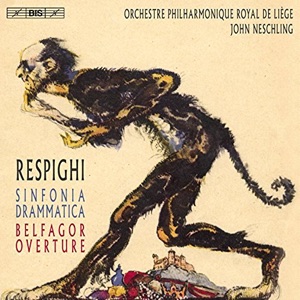
  • Neschling’s “Meh” Version Of Respighi’s “Meh” Symphony

    Respighi’s Sinfonia Drammatica has been recorded three times (at least): Nazareth on Naxos with the Slovak Philharmonic; Downes on Chandos with the BBC Philharmonic; and this one. All three offer similar timings, but the Nazareth remains the best. Granted, the Slovak Philharmonic is not a great orchestra, but for some reason the players sound right in this music. The work itself is a shapeless blob of fin-de-siècle Sturm und Drang, darkly scored with reckless excess, and thematically rather undistinguished. In the right hands, it can be fun. Downes is pretty good but a touch bland (typically), while the Slovak Phil players have a brightness and edge, especially in the brass and winds, that cut through the murk like a bracing dash of malt vinegar on a greasy order of fish and chips.

    This performance, on the other hand, is simply too dark, with recessed winds, backward percussion, and a generous focus on the bass drum and organ pedals that somehow weighs the textures down even more. Had this been the only available version it might not have mattered, but there is strong competition and in direct comparison the superiority of Nazareth’s rendition, particularly, is very evident. No complaints, though, about the Belgafor Overture, and this is the only version of the symphony that features a coupling–you’ll know if that makes this release more compelling.

    I don’t care anymore about SACD multichannel sound. The industry hasn’t supported the format to any degree, and I’m more than happy with good old-fashioned stereo. There’s no doubt that BIS’ engineering is very realistic. It’s just that in this particular work, that doesn’t especially help.

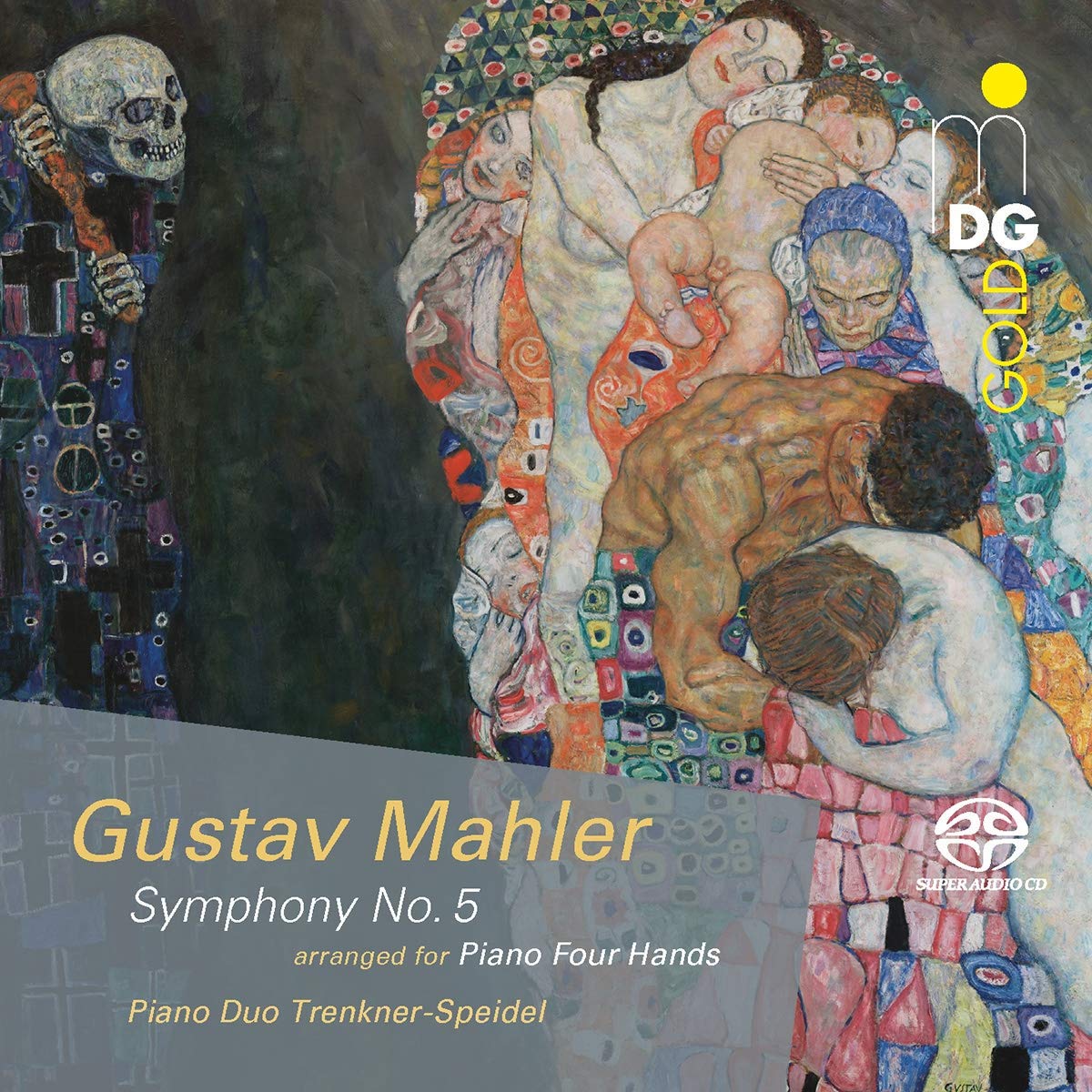
  • CD From Hell: More Underplayed Four-Hand Mahler

    Two decades back, the Trenkner/Speidel piano duo made fine recordings […]

    To access this content you must login to your Insider account, or purchase a subscription for $5 monthly, or $49 annually.
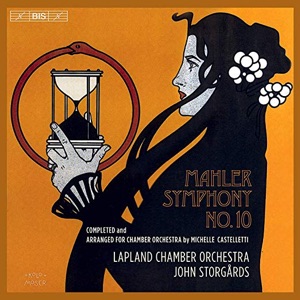
  • CD From Hell: Nano-Mahler Tenth Blows In On A Cold Wind from Lapland

    The Mahler parasites are at it again, feasting on the […]

    To access this content you must login to your Insider account, or purchase a subscription for $5 monthly, or $49 annually.
  • Elgar Lite from Gardner and the BBC

    It is an invariable rule that every self-respecting British label has to record the Elgar symphonies (and other stuff) every few years, just to try to convince the rest of the world that this composer really matters. Of course, the rest of the world seldom notices or cares, but I suppose it’s the thought that counts. This is Chandos’ at least third go-round with the Elgar symphonies, and none of them has been wholly successful. First we had Gibson, enthusiastic but hobbled by what was then an inferior Scottish orchestra. Next came Bryden Thomson, slow, soft-edged, and bloated.

    Now we have just the opposite to Thomson. Edward Gardner offers a lean, light-textured, curiously small-scale interpretation of the epic Second Symphony. At first, the zippy opening tempo and bouncy rhythms sound refreshing, but as soon as the music slows and quiets down for the first movement’s nocturnal development episode, we realize that Gardner has not provided sufficient contrast to carry us through the more reflective bits. The music wanders, and the ensuing climaxes lack the necessary punch, failing to build with the right sort of rhetorical emphasis.

    The second-movement funeral march probably comes off best, if only because its mood remains more or less consistently sustained throughout, but the central climax of the Rondo isn’t nearly as crushing as it needs to be–there’s no excuse for that–and the finale just goes nowhere. The elegiac coda sounds interminable here, and I’m not sure exactly why. Again, it seems to be a function of the quicker bits not providing enough contrast to justify the slower ones. If Gardner had only kept up his initial premise consistently we might have had something–sort of a more buoyant answer to Solti, perhaps, or something like that. As it is, I would call this performance a failed experiment.

    The coupled Serenade for Strings is okay, but it’s hard to work up much enthusiasm for this piece of sentimental Victorian fluff. Devoted Elgarians may bridle at this assessment, but there it is.