














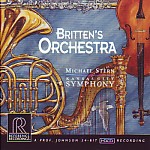
This is an impressive recording of these frequently encountered pieces. The Young Person’s Guide features excellent solo work from all departments, and a clarity of texture akin to Britten’s own recording. Michael Stern’s ability to let us hear not just the tunes but the imaginative colors of Britten’s accompaniments gives the music additional substance and continuity. The outer movements of the Sinfonia da requiem have real lyrical eloquence, though the central Dies irae could be a touch nastier, as could the “Storm” from the Four Sea Interludes.
Still, in this latter work Stern’s decision to play the Passacaglia between “Moonlight” and the “Storm” makes a great deal of sense, and the remaining movements have the same remarkable level of detail and color as The Young Person’s Guide. “Sunday Morning” has a particularly lively bounce, and in “Moonlight” you can actually hear the triplet rhythm of those little exclamations for xylophone and winds. Of course, the amazingly lifelike sonics help, but their very naturalness shows that credit for the interpretations belongs to conductor and orchestra and not the engineers. A first-rate experience, on both audiophile and musical grounds.